
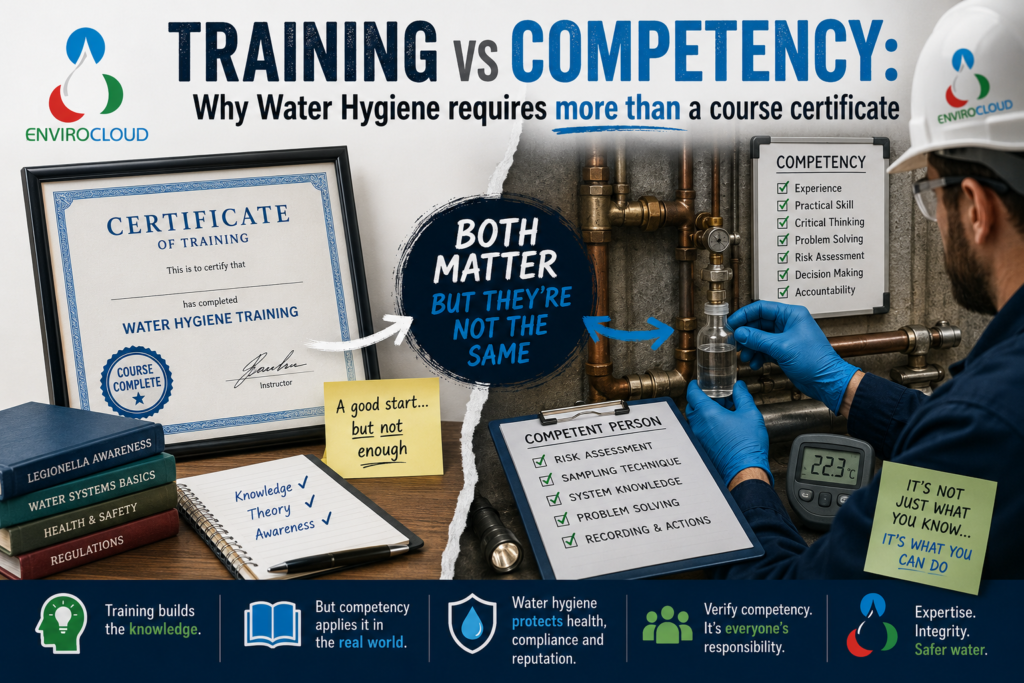
Training vs Competency; Why Water Hygiene requires more than a course certificate

Training vs Competency: Why Water Hygiene requires more than a course certificate

In Water Hygiene management, training is often treated as the big milestone — the thing

organisations proudly tick off. Courses, toolbox talks, elearning modules, refresher

sessions… they all matter. But training isn’t the finish line. It’s the starting point.

One of the most persistent misconceptions in our industry is the idea that attending a course

automatically makes someone competent. Competency isn’t handed out at the end of a

PowerPoint presentation. It’s built through application, assessment, and experience.

If we want safer healthcare environments, stronger estates teams, and better assurance for

Responsible Persons (Water), we need to shift our perspective. Training must be recognised

for what it truly is:

Training is the doorway to competency — not the competency itself.
Why this distinction matters in Water Hygiene

Water Hygiene management is a high-risk, high-consequence discipline. Decisions made by Duty Holders, Responsible Persons (Water), Authorised Persons (Water), and technicians directly influence patient safety, regulatory compliance, and organisational liability.

A person who has been “trained” but is not yet competent may:

  • Misinterpret monitoring data
  • Fail to recognise early signs of deterioration
  • Carry out tasks incorrectly or unsafely
  • Miss critical escalation points
  • Assume they understand the system when they do not

In healthcare environments, the gap between training and competency can translate into real harm. HTM 04-01, HSG274, and BS 8680 all emphasise the need for competent persons, not simply trained ones.

So how do we define competency in a way that is meaningful, measurable, and aligned with real-world performance?

The S.K.A.T.E. Model of Competency

Competency is multidimensional. It’s not a certificate, a job title, or a number of years served. It’s a blend of attributes that enable someone to perform safely, effectively, and consistently.

The S.K.A.T.E. model captures this perfectly:

Skill

The practical, hands-on capability to perform tasks correctly — from aseptic sampling (BS 7592) to temperature monitoring, flushing, TMV maintenance, and interpreting system behaviour.

Knowledge

Understanding the “why” behind the task: legislation, guidance, system design principles, microbiology basics, and risk factors.

Ability / Attitude

The personal attributes that shape performance: attention to detail, ownership, curiosity, willingness to escalate, and confidence to challenge unsafe practices.

Training

Formal instruction that introduces concepts, standards, and expectations. Training provides the foundation — but without the other elements, it remains theoretical.

Experience

Exposure to real systems, real problems, and real decision-making. Experience builds judgement, pattern recognition, and the ability to respond appropriately under pressure.

Why S.K.A.T.E. should matter to organisations

Relying solely on training creates a false sense of security. A certificate may satisfy a procurement checklist, but it doesn’t guarantee safe practice.

The S.K.A.T.E. model helps organisations:

  • Assess individuals holistically
  • Identify gaps training cannot fill
  • Build structured development pathways
  • Strengthen governance and assurance
  • Reduce risk by placing the right people in the right roles

It also supports Responsible Persons (Water) in demonstrating due diligence — something increasingly scrutinised by auditors, regulators, and insurers.

Competency is a journey, not an event

Competency develops over time through mentoring, supervised practice, reflective learning, and exposure to varied scenarios. It requires feedback, assessment, and ongoing support.

Training courses can establish important foundations, but they cannot replace:

  • Shadowing experienced engineers or consultants
  • Real-world troubleshooting
  • Understanding site-specific systems
  • Learning from incidents and near misses
  • Continuous professional development

In Water Hygiene, competency isn’t a badge — it’s a responsibility.

The role of the Authorising Engineer (Water)

An Authorising Engineer (Water) plays a pivotal role in bridging the gap between training and true competency. Acting as an independent assessor and advisor, the AE(W) provides objective scrutiny of both individuals and systems.

Through audits, interviews, and competency reviews, the AE(W) validates that Responsible Persons (Water), and their deputies possess not only the required training but also the demonstrable skills, knowledge, ability/attitude, and experience to manage water safety effectively.

This strengthens organisational assurance — confirming that competency is not assumed, but evidenced, maintained, and continually developed.

Final Thought

If we want safer systems and stronger compliance cultures, we must shift our mindset:

Training creates awareness. Competency creates safety.

The S.K.A.T.E. model gives organisations a practical framework to build, assess, and maintain competency — ensuring the people managing our water systems are not just trained, but truly capable.
Why More Universities Are Seeking Authorising Engineer (Water) Support  And Why It Makes Sense

Across the UK, we are seeing a noticeable increase in requests from universities and higher education estates teams for Authorising Engineer (AE(W)) support.

This isn’t surprising.

University estates are often some of the most complex, diverse and operationally demanding water systems in the country. From historic academic buildings and student accommodation to laboratories, sports facilities, healthcare linked spaces and catering areas, universities are responsible for managing a broad range of assets; all with very different water hygiene risks.

As expectations around governance, assurance and demonstrable compliance continue to rise, many universities are recognising the value of having access to independent AE(W) support.

Why universities are increasingly turning to AE(W) support

Higher education estates rarely stand still. Buildings change use, departments expand, refurbishments take place, and occupancy levels fluctuate dramatically throughout the academic year.

That creates a challenging environment for water safety.

Many universities are now reviewing whether their existing arrangements are robust enough to demonstrate that they are not only doing the right things, but also able to evidence that they are doing them consistently.

This is where AE(W) support becomes particularly valuable.

An AE(W) provides independent professional oversight to help ensure that water safety arrangements are suitable, proportionate, compliant and effective.

Rather than simply looking at isolated tasks or individual records, an AE(W) reviews the bigger picture:

  • governance structures;
  • roles and responsibilities;
  • Water Safety Group performance (if in place);
  • Water Safety Plan suitability;
  • contractor management;
  • risk assessment outputs;
  • monitoring regimes;
  • remedial action processes; and
  • overall compliance assurance.

For many universities, this level of independent review provides confidence that their systems are not just active, but properly controlled and strategically managed.

University estates are uniquely complex

Unlike many single use estates, universities often operate as a collection of mini environments, each with their own risk profile.

A typical university estate may include:

  • teaching blocks;
  • research laboratories;
  • halls of residence;
  • sports and leisure facilities;
  • food and beverage outlets;
  • engineering buildings;
  • healthcare or clinical teaching spaces;
  • specialist research areas; and
  • intermittently used or seasonal buildings.

Each of these environments can introduce different water hygiene considerations.

For example, student accommodation may bring issues around seasonal occupation and low use during holiday periods. Laboratories may contain specialist outlets or deadlegs created through historical change. Older academic buildings may present challenges around legacy systems, schematic accuracy, or storage and distribution arrangements that have evolved over decades.

That complexity can make it difficult for estates teams to maintain clear oversight across the whole estate without independent support.

Compliance today is about more than just “doing the PPMs”

One of the most common issues seen across large estates is the assumption that if monitoring, flushing, tank inspections, temperature checks and sampling are being completed, then compliance is automatically being achieved.

In reality, it is not that simple. Inadequate management, lack of training and poor communication have all been identified as contributory factors in outbreaks of Legionnaires’ disease.

Completing tasks is important; but true compliance depends on whether the management system behind those tasks is effective.

Universities are increasingly recognising the need to ask bigger questions such as:

  • Are the right outlets being monitored?
  • Are trends being reviewed, or just recorded?
  • Are responsibilities clearly defined and formally appointed?
  • Is the Water Safety Group functioning effectively?
  • Are risk assessment recommendations being properly tracked to completion?
  • Are contractors being independently challenged?
  • Are written schemes and Water Safety Plans aligned with what is actually happening on site?
  • Can the organisation clearly evidence decision making if challenged?

An AE(W) helps answer those questions.

The value of independent assurance

One of the strongest benefits of AE(W) support is independence.

Where a single contractor is responsible for monitoring, risk assessments, remedials and performance reporting, there can be limited independent challenge within the management process.

That does not automatically mean anything is wrong, but it can make it harder for organisations to objectively assess and prove whether arrangements are as robust as they could be.

Independent AE(W) support provides a fresh and experienced perspective.

It allows universities to:

  • challenge whether current arrangements remain appropriate;
  • validate whether contractors are delivering what is required;
  • identify gaps that may otherwise go unnoticed;
  • benchmark arrangements against recognised good practice; and
  • demonstrate governance and assurance to senior leadership.

This can be particularly useful where universities are managing large or multi-campus estates and need confidence that standards are being applied consistently.

Strong governance is becoming increasingly important

More universities are also seeking AE(W) support because water safety is no longer viewed purely as a maintenance issue.

It is now rightly recognised as a governance, compliance and risk management issue.

Senior estates leaders, compliance teams and health and safety professionals increasingly want assurance that:

  • governance arrangements are appropriate;
  • risk ownership is clear;
  • escalation routes are defined;
  • records are auditable; and
  • strategic oversight is in place.

This is especially important in large institutions where responsibility may be shared across estates teams, accommodation teams, building managers, contractors, capital projects and specialist service providers.

AE(W) support helps bring clarity and structure to that picture.

A good AE(W) should not just review technical compliance, they should also help universities understand whether the organisation itself is set up to manage water safety effectively.

Water Safety Groups are a key area of focus

A major reason universities are engaging AE(W) support is to strengthen or formalise their Water Safety Group (WSG) arrangements.

A well functioning WSG can make a huge difference to compliance and control.

It provides a forum for:

  • reviewing performance;
  • discussing risks and incidents;
  • tracking actions;
  • overseeing strategic changes;
  • reviewing sampling and monitoring trends; and
  • ensuring accountability.

However, in practice, many organisations find that WSGs can become inconsistent over time.

Meetings may be held, but actions are not always closed out. Attendance may not always include the right people. Terms of reference may be vague or outdated. Important topics such as recurring legionella positive results, PPM failures, schematic review and contractor performance may not be consistently addressed.

AE(W) support can help universities ensure that their WSG is not just a meeting in the diary, but a meaningful and effective control measure.

Supporting universities through change

Another reason why demand is increasing is the level of change taking place across the university sector.

Many estates are undergoing:

  • refurbishment programmes;
  • decarbonisation works;
  • building repurposing;
  • student accommodation upgrades;
  • capital replacement projects; and
  • rationalisation of older infrastructure.

Any change to a building or water system has the potential to affect water hygiene risk.

This is where AE(W) input can be particularly beneficial  helping ensure that water safety considerations are built into projects early, rather than being addressed after problems arise.

From design reviews and project oversight to recommissioning considerations and post-work assurance, AE(W) support can help universities navigate change more safely and more confidently.

The benefit is not just compliance, it is confidence

Ultimately, the value of AE(W) support goes beyond simply meeting a requirement.

It gives universities confidence that they:

  • understand their risks;
  • have appropriate controls in place;
  • can evidence compliance;
  • are challenging their arrangements properly; and
  • are reducing the likelihood of avoidable failures.

For estates teams already managing a huge range of operational pressures, that independent support can be extremely valuable.

It provides reassurance not only to operational teams, but also to:

  • directors of estates;
  • health and safety leads;
  • governance teams;
  • procurement teams; and
  • senior leadership.

In short, AE(W) support helps universities move from reactive compliance to confident assurance.

How Envirocloud can support

At Envirocloud, we are seeing a growing number of universities seeking support with:

  • independent AE(W) appointments;
  • Water Safety Group attendance and guidance;
  • annual or periodic AE(W) audits;
  • Water Safety Plan review and development;
  • review of roles, responsibilities and appointments;
  • contractor performance challenge and oversight;
  • compliance assurance reviews; and
  • project and estate change support.

Our approach is built around providing practical, independent and proportionate support that helps universities strengthen compliance while remaining realistic to the demands of complex estates.

Envirocloud can supply support at all levels, whether that is strategic oversight, periodic review, or a more embedded AE(W) function.

Final thoughts

The increase in demand for AE(W) support across UK universities reflects a positive shift.

It shows that more institutions are recognising the importance of independent oversight, stronger governance and clear assurance in water safety management.

For estates that are complex, changing or contractor heavy, AE(W) support is not just beneficial, it can be one of the most effective ways to improve visibility, strengthen control and support demonstrable compliance.

If your university is reviewing its current arrangements, now is a good time to ask a simple question:

“Do we know we are compliant or do we just hope we are?”

We’re proud to introduce the brand-new Envirocloud website – a fresh platform designed to showcase who we are, what we do, and how we can help you stay compliant with water safety regulations.

Our new site reflects our continued focus on providing industry-leading water compliance services. With a clearer layout, improved navigation, and updated content, we’ve made it easier than ever to understand how Envirocloud can support your organisation with reliable, expert-led solutions.

Specialists in Water Compliance

At Envirocloud, we provide a full range of services including risk assessments, consultancy, testing & analysis, and training. These are tailored to meet the needs of businesses across various sectors – from healthcare and housing to education, manufacturing, and beyond.

The new website has been designed to give potential and existing clients a clearer understanding of what we offer, how we work, and why we’re trusted by organisations across the UK. Whether you’re looking to meet specific compliance requirements or want long-term support with your water safety strategy, you’ll find everything you need to get started with us.

Focused on What Matters

Our aim with this site isn’t just to look better – it’s to serve as a straightforward, practical gateway to our services. You’ll now find:

  • Clear, Detailed Service Pages – Learn exactly what’s included in each of our offerings, and how we tailor them to your needs.
  • Sector-Specific Solutions – See how we support businesses in your industry and the challenges we help solve.
  • Easy Contact Options – Whether you want to request a quote, schedule a service, or speak to an expert, getting in touch is simple and quick.

More to Come

While our primary focus is delivering quality services, we will be adding select updates and insights over time to help clients make informed decisions about their compliance needs. This may include key regulatory updates, training announcements, and examples of how we’ve helped other clients meet their obligations.

Let’s Work Together

We’re excited about what this new site represents – a stronger, more accessible way to present our services and engage with our clients. We invite you to explore the site, get to know what we offer, and contact us to discuss how we can support your compliance goals.

We’re thrilled to share some exciting news: Envirocloud Ltd has been named Water Safety & Compliance Leader of the Year 2025 at the SME News – UK Enterprise Awards.

This national recognition is a proud moment for our team, and a true testament to the dedication, expertise and high standards we bring to every project. As a company committed to helping organisations meet their water safety obligations with confidence, being acknowledged in this way reinforces what we strive for every day – delivering exceptional service and leading the way in compliance.

Envirocloud - Water Safety & Compliance Leader of the Year 2025-v2

Recognition of Excellence

The UK Enterprise Awards are designed to celebrate the very best that the country’s small and medium-sized businesses have to offer, across a range of sectors. Receiving this award from SME News highlights our role as a trusted and forward-thinking provider in the field of water safety and compliance.

Whether through detailed risk assessments, professional consultancy, rigorous testing & analysis, or our targeted training services – we take pride in offering practical, reliable solutions that support businesses across the UK in maintaining safe, compliant water systems.

Thank You to Our Clients and Partners

This achievement wouldn’t be possible without the continued support of our clients and partners. We’re genuinely grateful for the trust placed in us, and for the collaborative relationships that help drive our shared success.

What This Means for You

For both current and prospective clients, this award provides further assurance that when you choose Envirocloud, you’re working with a recognised leader in the industry. We bring not only compliance expertise, but also a proactive and personalised approach that ensures your organisation meets its responsibilities with clarity and peace of mind.

As we continue to grow, we remain focused on developing our services, supporting our clients, and staying at the forefront of best practice and regulatory standards in the water compliance sector.

Looking Ahead

We’re excited about what the future holds and will continue striving to set the standard in water safety and compliance across the UK. Thank you for being part of our journey so far – we look forward to achieving even more together.

To learn more about our award-winning services or to speak to us about how we can support your business, get in touch today.