

Training vs Competency; Why Water Hygiene requires more than a course certificate
Training vs Competency: Why Water Hygiene requires more than a course certificate
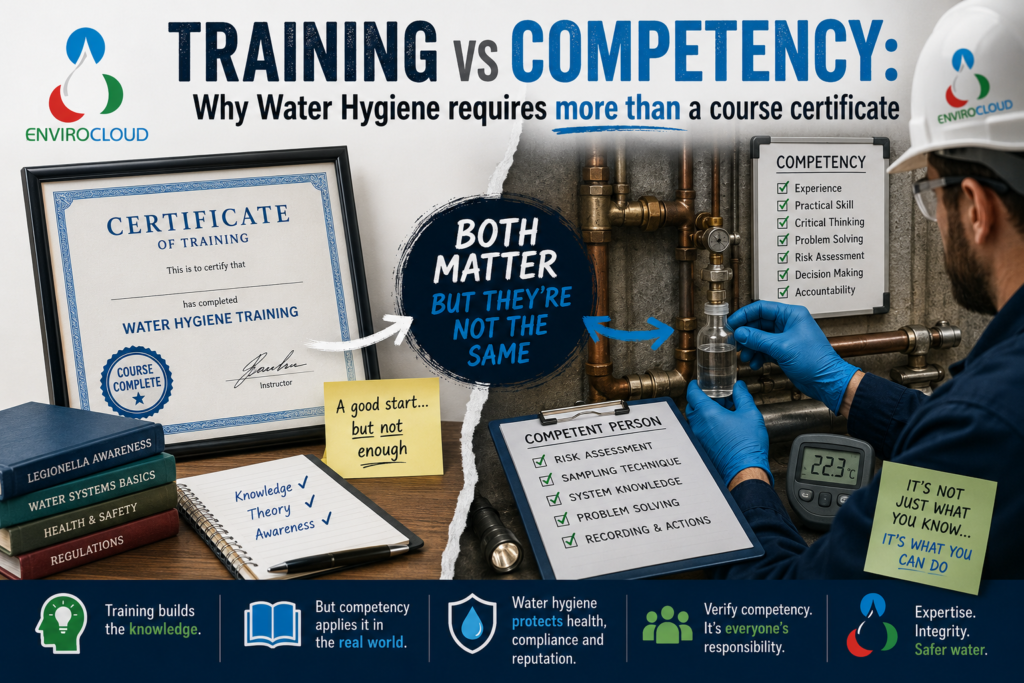
In Water Hygiene management, training is often treated as the big milestone — the thing
organisations proudly tick off. Courses, toolbox talks, elearning modules, refresher
sessions… they all matter. But training isn’t the finish line. It’s the starting point.
One of the most persistent misconceptions in our industry is the idea that attending a course
automatically makes someone competent. Competency isn’t handed out at the end of a
PowerPoint presentation. It’s built through application, assessment, and experience.
If we want safer healthcare environments, stronger estates teams, and better assurance for
Responsible Persons (Water), we need to shift our perspective. Training must be recognised
for what it truly is:
Training is the doorway to competency — not the competency itself.
Why this distinction matters in Water Hygiene
Water Hygiene management is a high-risk, high-consequence discipline. Decisions made by Duty Holders, Responsible Persons (Water), Authorised Persons (Water), and technicians directly influence patient safety, regulatory compliance, and organisational liability.
A person who has been “trained” but is not yet competent may:
- Misinterpret monitoring data
- Fail to recognise early signs of deterioration
- Carry out tasks incorrectly or unsafely
- Miss critical escalation points
- Assume they understand the system when they do not
In healthcare environments, the gap between training and competency can translate into real harm. HTM 04-01, HSG274, and BS 8680 all emphasise the need for competent persons, not simply trained ones.
So how do we define competency in a way that is meaningful, measurable, and aligned with real-world performance?
The S.K.A.T.E. Model of Competency
Competency is multidimensional. It’s not a certificate, a job title, or a number of years served. It’s a blend of attributes that enable someone to perform safely, effectively, and consistently.
The S.K.A.T.E. model captures this perfectly:
Skill
The practical, hands-on capability to perform tasks correctly — from aseptic sampling (BS 7592) to temperature monitoring, flushing, TMV maintenance, and interpreting system behaviour.
Knowledge
Understanding the “why” behind the task: legislation, guidance, system design principles, microbiology basics, and risk factors.
Ability / Attitude
The personal attributes that shape performance: attention to detail, ownership, curiosity, willingness to escalate, and confidence to challenge unsafe practices.
Training
Formal instruction that introduces concepts, standards, and expectations. Training provides the foundation — but without the other elements, it remains theoretical.
Experience
Exposure to real systems, real problems, and real decision-making. Experience builds judgement, pattern recognition, and the ability to respond appropriately under pressure.
Why S.K.A.T.E. should matter to organisations
Relying solely on training creates a false sense of security. A certificate may satisfy a procurement checklist, but it doesn’t guarantee safe practice.
The S.K.A.T.E. model helps organisations:
- Assess individuals holistically
- Identify gaps training cannot fill
- Build structured development pathways
- Strengthen governance and assurance
- Reduce risk by placing the right people in the right roles
It also supports Responsible Persons (Water) in demonstrating due diligence — something increasingly scrutinised by auditors, regulators, and insurers.
Competency is a journey, not an event
Competency develops over time through mentoring, supervised practice, reflective learning, and exposure to varied scenarios. It requires feedback, assessment, and ongoing support.
Training courses can establish important foundations, but they cannot replace:
- Shadowing experienced engineers or consultants
- Real-world troubleshooting
- Understanding site-specific systems
- Learning from incidents and near misses
- Continuous professional development
In Water Hygiene, competency isn’t a badge — it’s a responsibility.
The role of the Authorising Engineer (Water)
An Authorising Engineer (Water) plays a pivotal role in bridging the gap between training and true competency. Acting as an independent assessor and advisor, the AE(W) provides objective scrutiny of both individuals and systems.
Through audits, interviews, and competency reviews, the AE(W) validates that Responsible Persons (Water), and their deputies possess not only the required training but also the demonstrable skills, knowledge, ability/attitude, and experience to manage water safety effectively.
This strengthens organisational assurance — confirming that competency is not assumed, but evidenced, maintained, and continually developed.
Final Thought
If we want safer systems and stronger compliance cultures, we must shift our mindset:
Training creates awareness. Competency creates safety.
The S.K.A.T.E. model gives organisations a practical framework to build, assess, and maintain competency — ensuring the people managing our water systems are not just trained, but truly capable.